Is your hot water system leaking? Repair it if the water is coming from a valve, a fitting or the drain valve, and replace it if the water is coming from the inner tank, because a perforated tank cannot be patched. Everything else is details about how you tell those two apart.
A hot water system leaking in the side yard is one of the more stressful things to find on a Saturday morning, and the panic usually comes from not knowing which of those two you are looking at. This guide takes you through what to do in the first ten minutes, how to trace where the leak actually starts and how we decide between a repair and a complete replacement.
I'm George, and GSK Plumbing Solutions does residential maintenance plumbing across Hurstville and the St George area of southern Sydney.
Hot Water System Leaking: What To Do In The Next Ten Minutes
Before you work out the cause, make the situation safe and stop it getting worse. But how can you do that?
- 1
Turn off the energy. For electric systems, switch off the circuit breaker labelled for hot water at the board, or pull the plug at the power point if it has one. For gas systems, close the gas valve at the unit.
- 2
Shut the cold water supply. There is a cold water isolation valve on the pipe entering the unit. Turn it clockwise until it stops. If you cannot find it, turn off the mains tap at the water meter.
- 3
Get water away from anything electrical. Do not touch wiring, covers or the thermostat housing while they are wet.
- 4
Move what the water can ruin. Boxes, tools and anything stored against the wall.
- 5
Photograph it. Where the water is pooling, how much there is, and the unit's compliance plate. That helps your plumber and your insurer.
- 6
Note the colour. Clear water is one story, discoloured water with visible rust is another.
A system with the water and power off will keep whatever is already in the tank hot for a while, so you are not necessarily cold until it is fixed.
Find Where The Hot Water Leak Starts, Not Where It Lands
A hot water cylinder sheds water down its outside and drips off the lowest point, so the puddle on the ground almost never sits under the fault. This is the single most common reason people replace a whole system that needed a seal.
Here is the test. Wipe the unit and the surrounding floor completely dry. Tape a strip of paper towel vertically up the side of the tank, mop the floor, then leave it alone for fifteen minutes. Wherever the paper towel wets first is where your leak starts.
If it is unclear, repeat the test after a heating cycle, because some leaks only appear as the water temperature rises and the pressure generated inside the tank increases. That is also why a leak can happen intermittently and leave you doubting yourself.
Signs Of A Leak You Might Not Have Spotted
Not every leak announces itself with a puddle. Some of it hides inside a wall or under the slab, and you notice the symptoms before you ever see water.
- A drop in water pressure or temperature: Water escaping before it reaches the tap shows up as weaker flow and shorter showers.
- Higher than normal water bills: A hidden hot water leak runs day and night and lands on the bill before it lands on the floor.
- Unusual sounds: Trickling, hissing or popping around the unit when no tap is open is worth investigating.
- Rust or staining around fittings: Corrosion around a connection is the slow version of a leak you will see properly later.
- A musty smell or soft plasterboard on the other side of the wall the unit sits against.
How To Tell Condensation From An Actual Leak
On hot summer days a cold inlet pipe and a cool tank skin will sweat, and that water can look exactly like a leak on the floor.
To tell the difference, dry everything and watch for fifteen minutes. Condensation forms as a fine film across a broad area. A real leak has a source you can point at, and it keeps producing water even after you've dried it twice.
Discoloured water settles the question straight away. Condensation is clear, but water carrying rust or tiny particles of built up sediment has come from inside the tank.
Leaking From The Relief Valve Or Overflow Pipe
Most hot water systems have two safety valves: a temperature relief function and a pressure relief valve, usually combined in one PTR valve with a copper drain line running down the side.
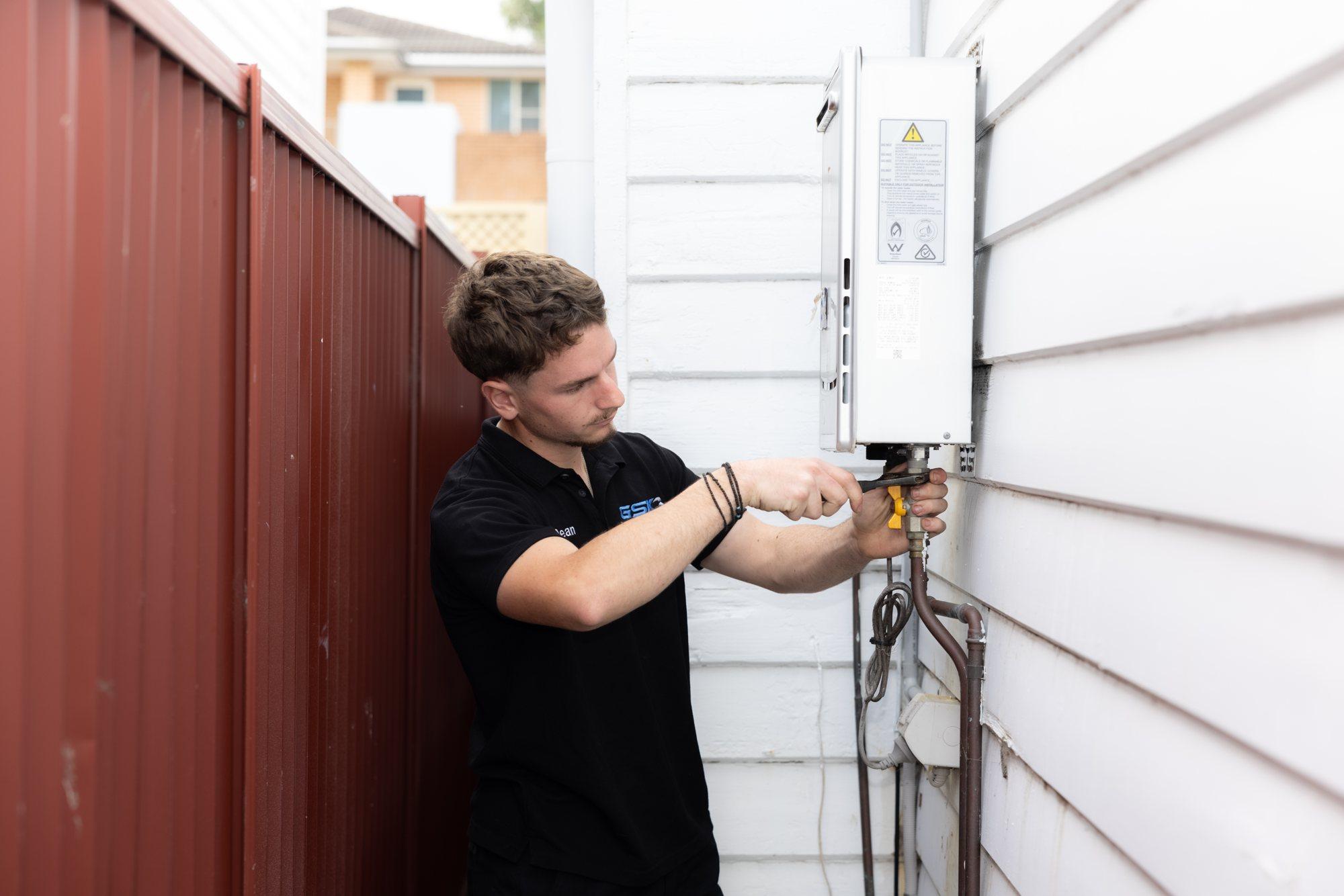
That valve is a safety device, so it's meant to release water. The unit keeps heating perfectly well while the valve misbehaves, which is why people leave it for months. An occasional drip during a heating cycle or a short discharge on a hot afternoon is simply the valve doing its job, as the pressure built up by heating pushes past its setting.
What is not normal is a constant stream, or water dripping all day with no pattern. That usually means the valve has stopped sealing properly, often because sediment has lodged under its seat. A PTR valve wears out much sooner than the tank does, so replacing one is routine maintenance rather than bad news.
To work out which you have, put an empty ice cream container under the end of the drain line for an hour and look at roughly how much water it has caught. A few spoonfuls is normal. A full container is a fault.
Never cap, plug or tie off that pipe. It is the only thing stopping pressure building in a sealed vessel, and blocking it is how a leak turns into major property damage.
High water pressure on the mains makes an otherwise healthy valve weep. If that is the cause, the fix is a pressure limiting valve or an expansion control valve on the inlet, not a new water heater.
Leaking From The Bottom Or The Inner Tank
This is the one that decides the system's future.
Start with the easy causes. The drain valve at the base often weeps from a loose connection or a worn washer, and that is a cheap repair. On electric systems, the lower element seal is the next suspect, and a failed element gasket is also a repair rather than a replacement.
If both of those are dry and water is still arriving at the base, feel the insulation through the lower access panel. Wet insulation means the inner tank has corroded through from the inside, and a leaking hot water tank in that condition is the end of the system. There is no patch, no sealant and no weld that is safe on a pressure vessel full of hot water.
Tank corrosion is what the sacrificial anode exists to prevent. Once it has been consumed and nobody replaced it, the steel is next.
Top Connections And The Cold Water Supply
Leaks at the top are the best news of the lot, because the fittings are accessible and the tank is fine.
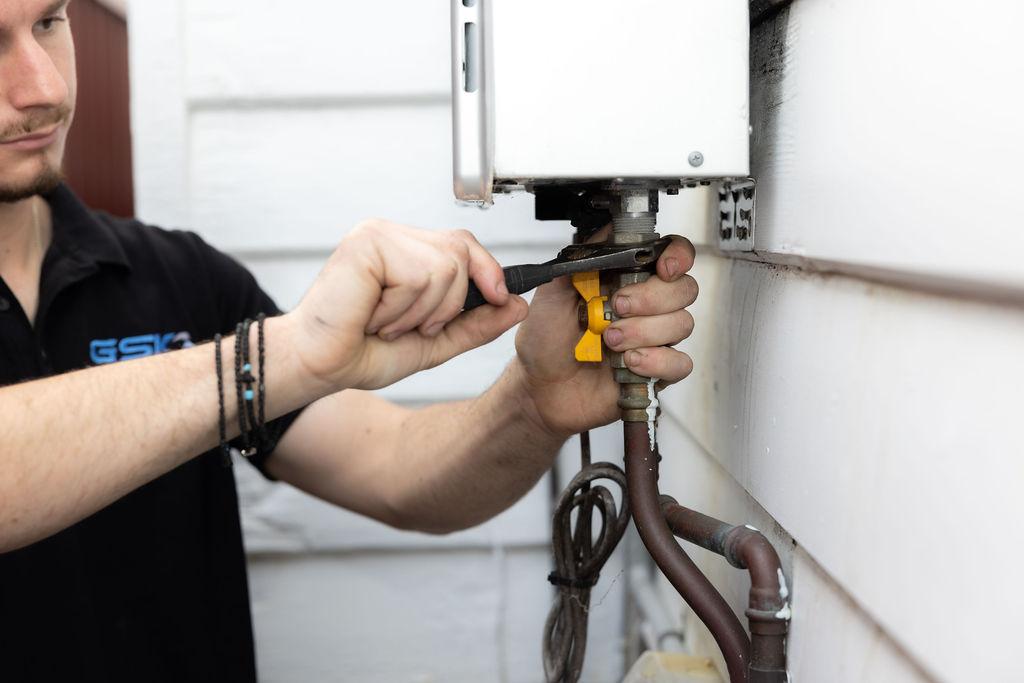
Look at the cold water inlet and the hot water outlet connections, the flexible connectors if there are any and the cold water supply valve itself. A loose connection, a perished washer or a corroded compression fitting will all drip and all three are straightforward repairs.
A leak at the top is also worth fixing promptly for a reason people miss: it runs down the outside of the unit, sits in the insulation and starts corroding the jacket and the electrical components from the outside in.
Hot Water System Leaking Near Electrical Components
Water and electricity near each other change the order of operations. Safety comes before diagnosis.
Switch off the hot water circuit breaker at the switchboard before you go near the unit. Do not open an electrical cover, do not pull a panel and do not touch the thermostat or a faulty thermostat's wiring while anything is damp.
If water has reached the wiring, the power supply terminals or inside the electrical enclosure, that is a licensed electrician's job as well as a plumber's. Leave it off until both have been.
Solar systems add a wrinkle, because the roof collectors and their connecting pipework can leak somewhere you cannot see from the ground, and the water then tracks down inside a wall or ceiling. Heat pump systems have a condensate drain that is supposed to produce water, so check that before assuming the worst.
Repair Or Replace: How We Decide
| What you found | Repair or replace | Why |
|---|---|---|
| Drip from the PTR valve only during heating | Neither, monitor it | The safety valve is working as designed |
| Constant stream from the relief valve | Repair | The valve has stopped sealing properly and is replaceable |
| Valve weeping with high water pressure | Repair | Fit a pressure limiting or expansion control valve on the inlet |
| Drip at the drain valve | Repair | Washer or loose connection at an accessible fitting |
| Leak at top fittings or the cold water inlet | Repair | Accessible connections, the tank is sound |
| Leak at the lower element seal | Repair | The gasket and element are serviceable parts |
| Wet insulation, water from the base of the tank | Replace | The inner tank has corroded through and cannot be repaired |
| Visible rust through the outer jacket | Replace | Corrosion has gone past the point of a reliable repair |
| Discoloured water plus a leak on an old unit | Usually replace | The tank is deteriorating from the inside |
A leaking tank is the only line in that table with no way back. Age sits on top of the rest of it. A young system with a valve fault is an easy repair. An old system is a different calculation, because the repair costs money on a unit that is approaching the end of its working life anyway. Once a repair starts costing a serious fraction of a new system, replacing the whole system is the better buy.
A common rule of thumb in the trade is that once a repair approaches half the cost of a new system, you are better off replacing it. Most storage systems have a working life of roughly a decade, give or take, depending on water quality and how well they have been looked after, so a valve fault on a young unit and the same fault on a tired one are genuinely different decisions.
Maintenance history matters too. A tank whose anode has been replaced on schedule and that has been flushed is worth repairing further into its life than one that has never been touched.
What A Replacement Actually Involves
A like for like swap is the simplest version of the job, and the one most households are facing. Same fuel, same type, same position, so the existing pipework and the existing circuit or gas line stay as they are.

If you change type, the job grows. Moving from a tank to a continuous flow unit, or from gas to an electric heat pump, means new pipework and new electrical or gas work, and heat pump systems cost more to buy even though they are much less energy consuming to run.
A few things to settle with your plumber before the work starts:
Tempering valve: Current rules require delivered water to be limited in temperature at the bathroom outlets, so a replacement is usually when that gets brought up to standard.
Positioning: A new unit may need a different clearance or a different drain line route than the old one.
Disposal: Confirm the old unit and its water are taken away as part of the job.
Paperwork: Keep the compliance certificate, the warranty and the installer's details together. You will want them in several years.
Preventing The Next Leak
A few small habits go a long way towards keeping your new system from leaking. Nothing here is difficult and all of it buys you years.
- 1
Ease the PTR valve lever every six months so sediment does not set under the seat. Stand clear, the water that comes out is hot.
- 2
Drain a bucket from the drain valve once a year to pull out sediment buildup before it insulates the base of the tank.
- 3
Have the sacrificial anode checked every few years and replaced when it has gone. This is the single cheapest thing that extends a tank's life.
- 4
Check your mains water pressure. Sustained high water pressure shortens the life of every valve and fitting in the house, not only the hot water system.
- 5
Look at the unit now and then. Visible rust, water pooling, a damp patch under the overflow and discoloured water from the hot tap are all early warnings.
- 6
Watch the water meter with everything off. If it is still ticking over, something is leaking somewhere.
When To Call A Professional
Some of this is a look-and-see job. Some of it is not.
Call a licensed plumber the same day if water is streaming rather than dripping, if the base of the tank is leaking, if you can smell gas anywhere near the unit or if water has reached electrical components. A streaming leak on a pressurised system is an emergency plumber call, not a Monday problem.
Gas work, PTR valve replacement on a pressurised vessel and tempering valve compliance all have to be done by a licensed tradesperson in NSW, and you can check a licence through NSW Fair Trading. Guidance on running and maintaining hot water at home is published by the federal government's energy advice for households, and NSW Health sets out why hot water temperature control matters for safety and scalding.
Avoid the DIY temptation on anything that holds pressure. Tightening a weeping fitting a little is fair enough. Dismantling a valve on a full tank is not.
Leaking Hot Water System FAQs
It depends on the volume. A drip from the relief valve during heating is normal and can wait. While a constant stream of water at the base of the tank, water near electrical components or any smell of gas is urgent, both for safety and because water running against a wall for a day can cause major property damage.
There are three usual causes: the drain valve, the lower element seal on electric systems, or the inner tank itself. The first two are repairs. If the insulation around the base is wet, the tank has corroded through and needs replacing.
For a small leak at a fitting, usually yes, for a short time, while you get it looked at. For anything streaming, or any leak near wiring, shut the water and the power off and stop using it. You can still shower on what is already in the tank for a while after shutting it down.
That depends entirely on what is leaking. A valve, a washer or a fitting is at the small end. An element and gasket is in the middle. A failed inner tank means a new system, which is why diagnosis matters so much before anyone starts quoting. We will tell you which of those three you have before any work is agreed.
No. A storage tank is a pressure vessel holding water above normal temperature, and sealants, patches and welds on a corroded tank are not safe and will not hold. Once the inner tank leaks, replacement is the only sound option.
A valve or fitting leak has no bearing on the tank's life once it is fixed. A leaking inner tank is different: it can go from a weep to a failure within days and with little warning, so treat it as a replacement to plan this week rather than this year.
For more on what we look at and what a changeover involves, see our hot water services page, or our burst pipes page if the leak turns out to be in the plumbing rather than the unit.

Need help with a leaking hot water system?
Get fast, reliable hot water repairs and replacements across Hurstville and the St George area.